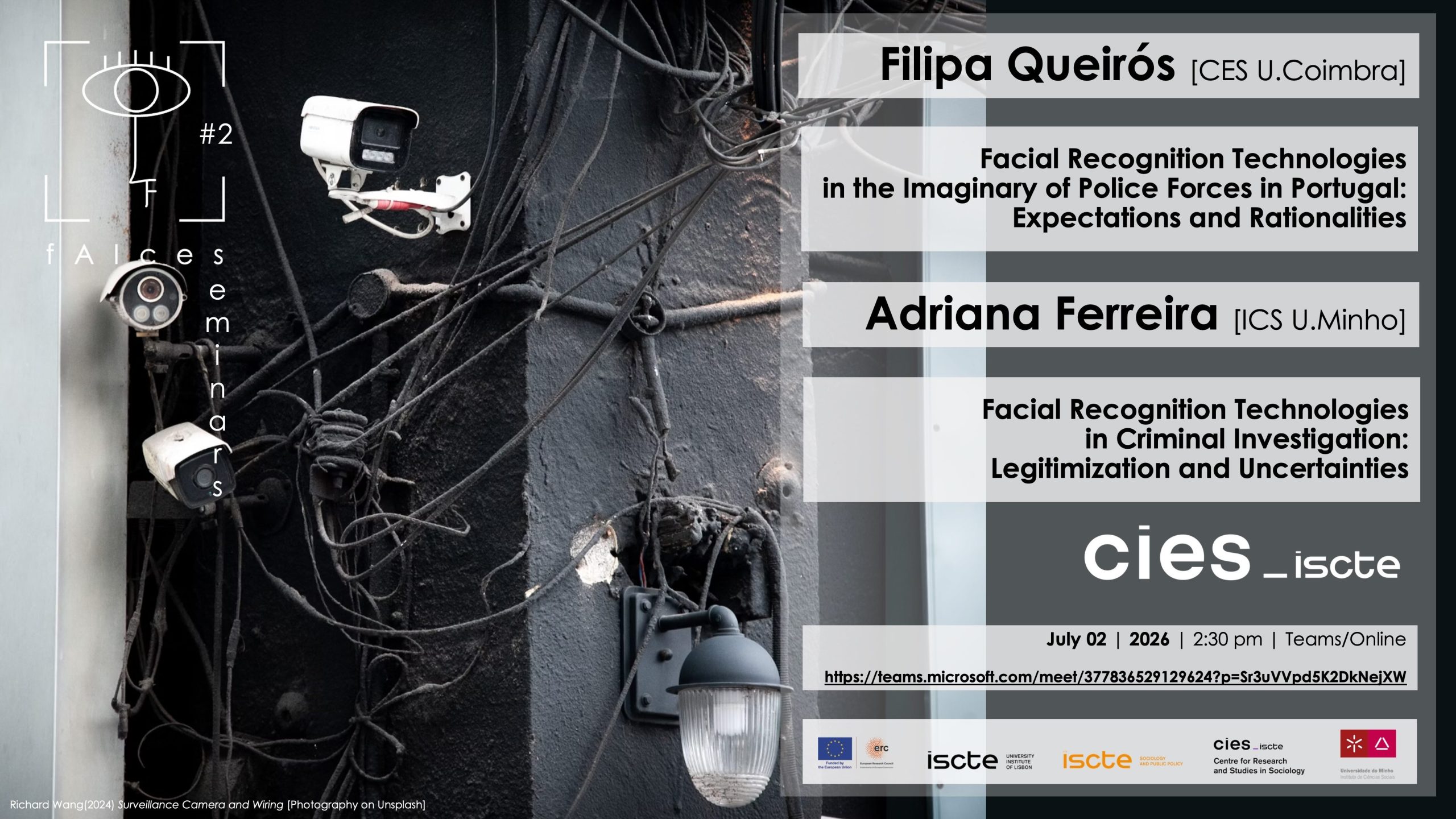
Filipa Queirós (CES, U.Coimbra) presented “Facial Recognition Technologies in the Imaginary of Police Forces in Portugal: Expectations and Rationalities”.
While Adriana Ferreira (Department of Sociology – ICS, U.Minho) discussed “Facial Recognition Technologies in Criminal Investigation: Legitimization and Uncertainties”.
The seminar was held online via Microsoft Teams and hosted by the Centre for Research and Studies in Sociology (CIES-Iscte).
Read More
Filipa Queirós (Centre for Social Studies, University of Coimbra)
Facial Recognition Technologies in the Imaginary of Police Forces in Portugal: Expectations and Rationalities
In a context marked by the absence of a specific legal framework and the proliferation of heterogeneous visual sources in criminal investigations, Portuguese police forces portray facial recognition technology as an inevitable part of the process of technological modernization. By relegating the use of this tool to the unofficial sphere of criminal intelligence, the interviewees create an evidentiary “black box” that remains invisible to the courts and to public scrutiny. Grounded in the institutional belief that digital images represent an unquestionable truth, the presentation problematizes how this perspective normalizes biometric surveillance and evades critical scrutiny regarding the construction of criminal suspicion.
Adriana Ferreira (Department of Sociology, Institute of Social Sciences, University of Minho)
Facial Recognition Technologies in Criminal Investigation: Legitimization and Uncertainties
In a context of growing development of facial recognition technologies (FRTs) and increasing debate surrounding their use in security matters, criminal investigators from the Judicial Police tend to view these tools as potentially important for the future of criminal investigations, highlighting their usefulness in identifying suspects and enhancing investigative effectiveness. However, this favorable perception does not amount to unconditional acceptance. The findings reveal a logic of conditional acceptability, whereby the legitimacy of these technologies depends on the existence of an appropriate legal framework, institutional oversight, human validation, and the protection of fundamental rights. Recognizing the risks associated with false positives, algorithmic bias, and the improper use of biometric data, the presentation examines the conditions under which FRTs may be considered legitimate in a democratic society.